 Accounting & reporting
Accounting and reporting
How US GAAP, IFRS and ESEF reporting works in practice, with real company examples: revenue recognition, leases, acquisitions and the standards that change what companies report.
Analysis
Two Industrial Peers, Two Adjusted Margins: Ingersoll Rand and Atlas Copco in Q3 2026
Ingersoll Rand reported a 28.3% adjusted EBITDA margin for Q3 2026, Atlas Copco 21.3% adjusted operating. Rebuilt on one basis the gap reverses to 0.4 points.
Learn
Company financial data Europe: what rules force into filings
Company financial data Europe is shaped by EU accounting, listing, and tax transparency rules, then surfaced in annual filings and notes.
Learn
Nordic company data: where to find it in the primary filings
Reliable Nordic company data comes from the companies' own interim reports, ESEF annual reports and stock exchange releases. Where to download them, how to use the reporting calendar and how to compare peers, with UPM, Stora Enso and Metsä Board.
Learn
8-K earnings release vs 10-Q: which numbers arrive first
The 8-K earnings release is the first publication of a US company's quarter: headline GAAP figures, non-GAAP measures and guidance. The 10-Q follows with full statements, segments and year-to-date cash flow. We walk through Johnson & Johnson's Q3 2026.
Learn
Comparing US GAAP and IFRS on a company financials platform
A company financials platform puts US GAAP and IFRS statements in one shape, but presentation, operating profit, leases and cash flow classification still differ. We show what to check, using Cisco and Nokia.
Learn
Annual report search for risk: 10-K Item 1A vs Nordic reports
US risk factors sit in one place, 10-K Item 1A; Nordic risks are spread across the board of directors' report and the notes. We show how to search both, with cited passages from three FY2025-FY2026 reports.
Learn
Company financial data in Europe: what ESEF covers and misses
ESEF makes the primary statements in EU listed companies' annual reports machine-readable, but notes, segments, adjusted measures and quarterly reports remain largely outside it. We show what that means for company financial data in Europe, using UPM-Kymmene's FY2025 figures.
Analysis
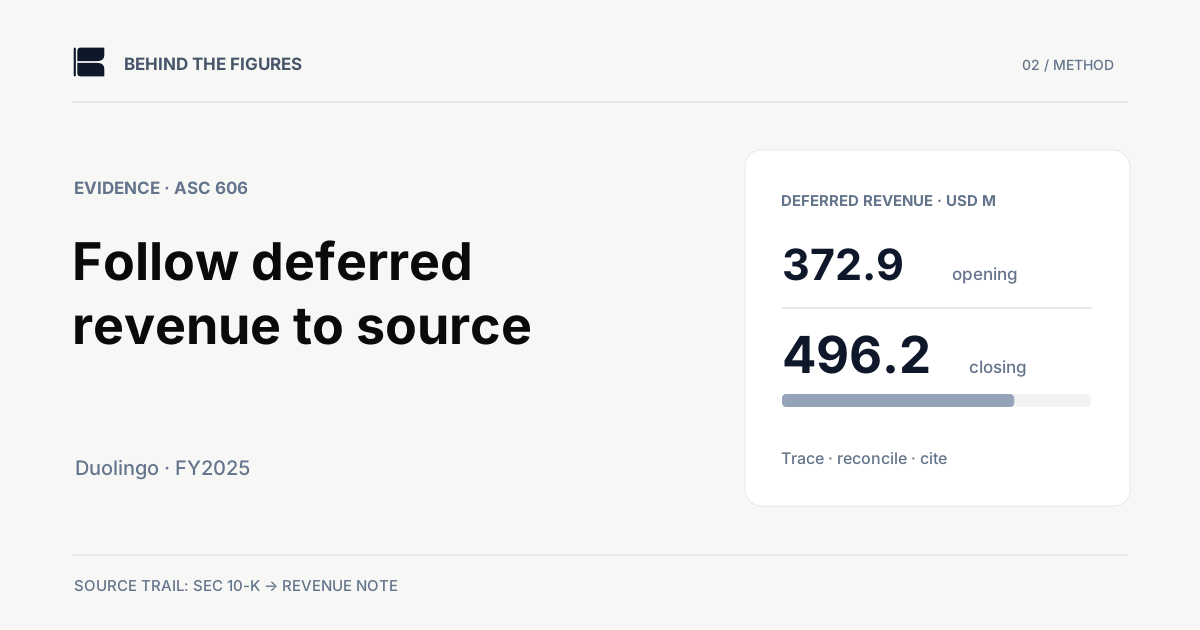
Behind the Figures: Duolingo's Deferred Revenue Reconciliation
How to research Duolingo's ASC 606 disclosures with Clarifo, reconcile the $496.2M deferred revenue balance and document reported versus calculated figures.
Analysis
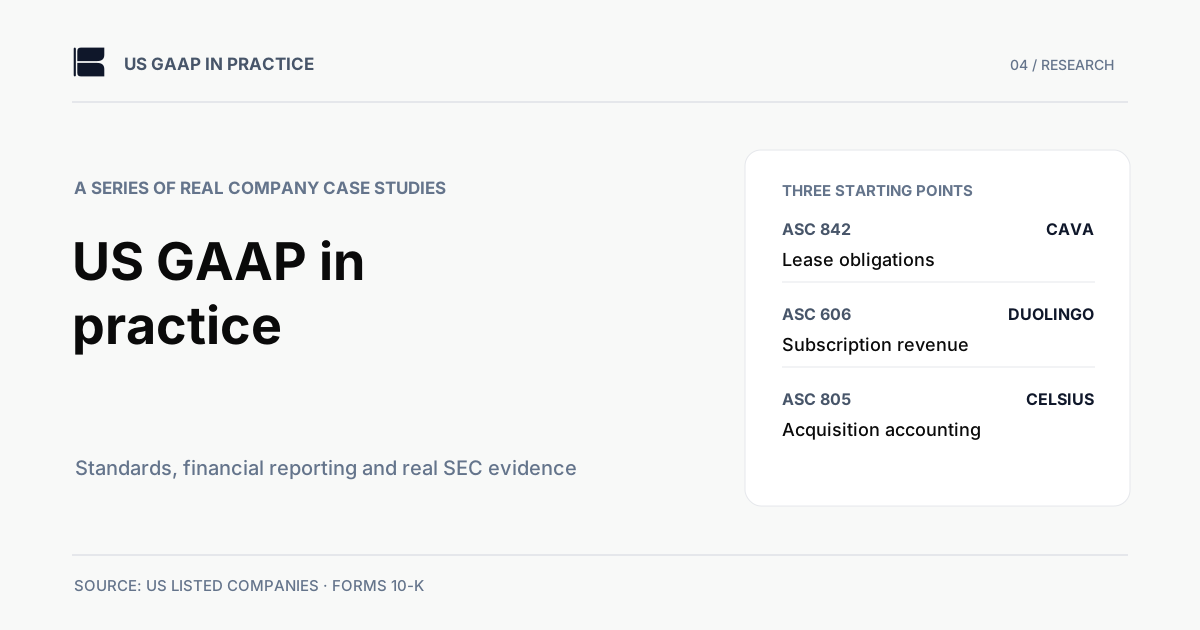
US GAAP in Practice: Real Company Accounting Examples
Explore US GAAP through real CAVA, Duolingo and Celsius accounting case studies, with separate Behind the Figures research workflows.
Analysis
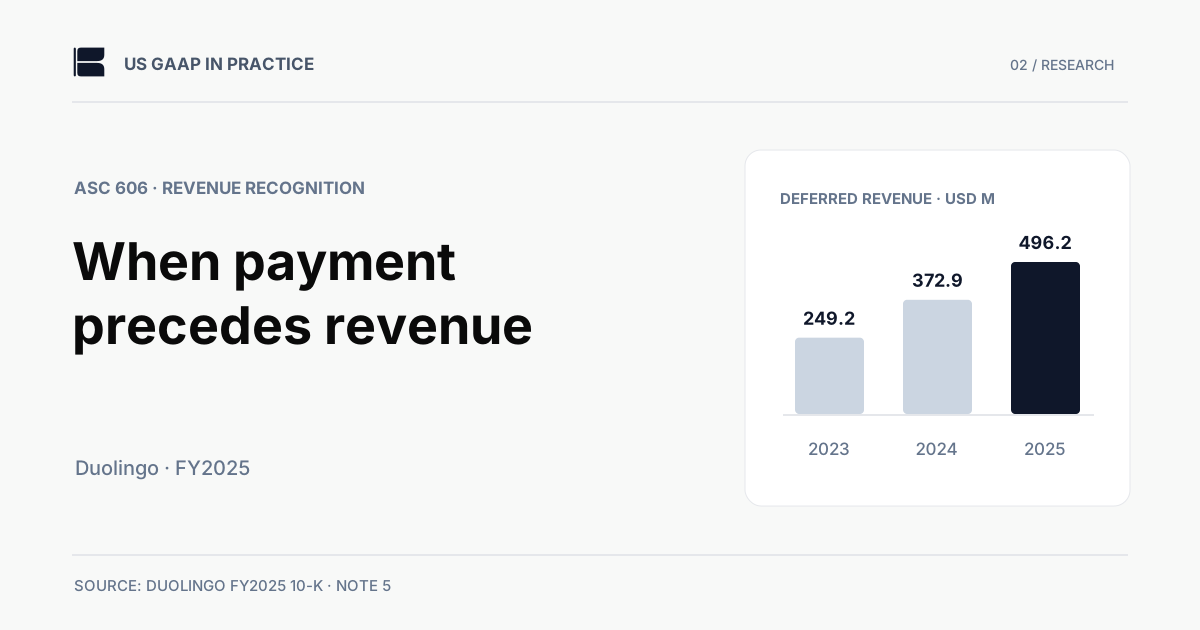
ASC 606: Why Duolingo's $496M Is Not Yet Revenue
Duolingo ended FY2025 with $496.2M in deferred revenue. A real ASC 606 case study on subscription payments, revenue recognition and contract liabilities.
Analysis
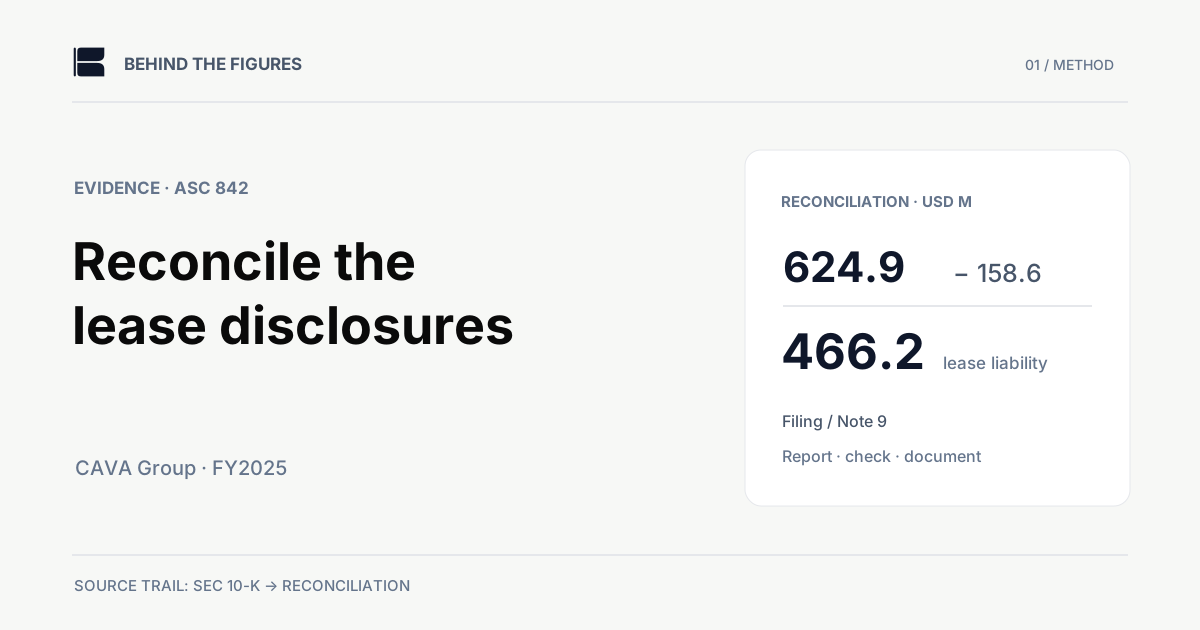
Behind the Figures: CAVA's ASC 842 Lease Reconciliation
How to use Clarifo to find CAVA's lease note, reconcile $624.9M in future payments to its $466.2M liability, and document ASC 842 findings.
Analysis
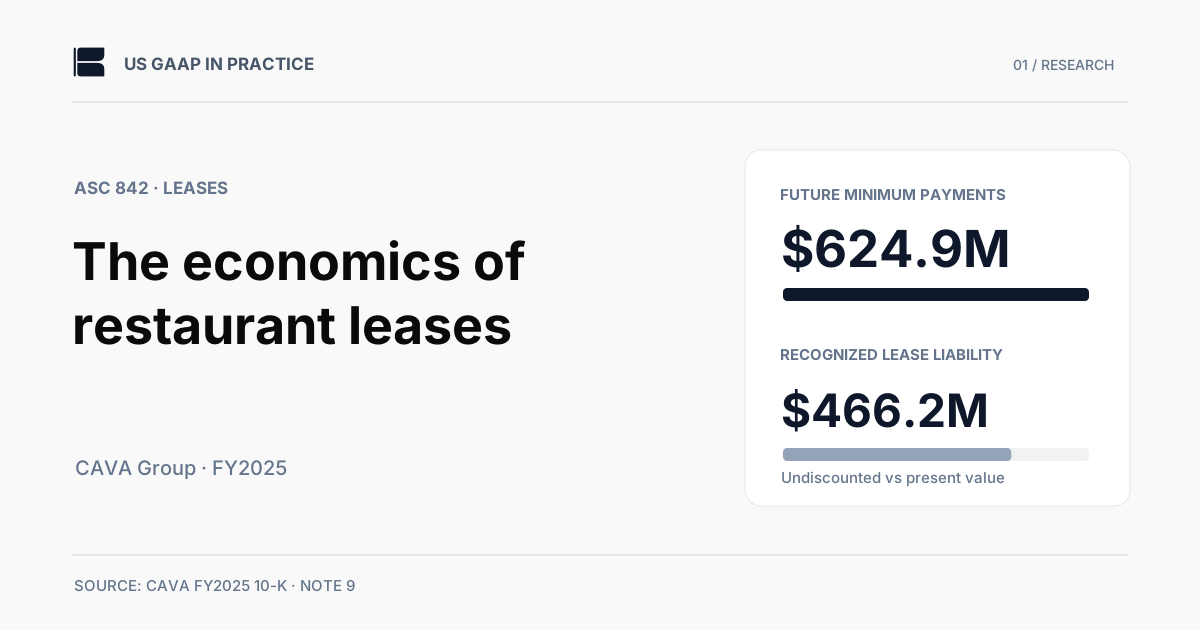
ASC 842 in Practice: CAVA's $625M Lease Commitments
CAVA reports $624.9M of future lease payments against a $466.2M operating lease liability. A real ASC 842 case study for understanding restaurant obligations.
Analysis
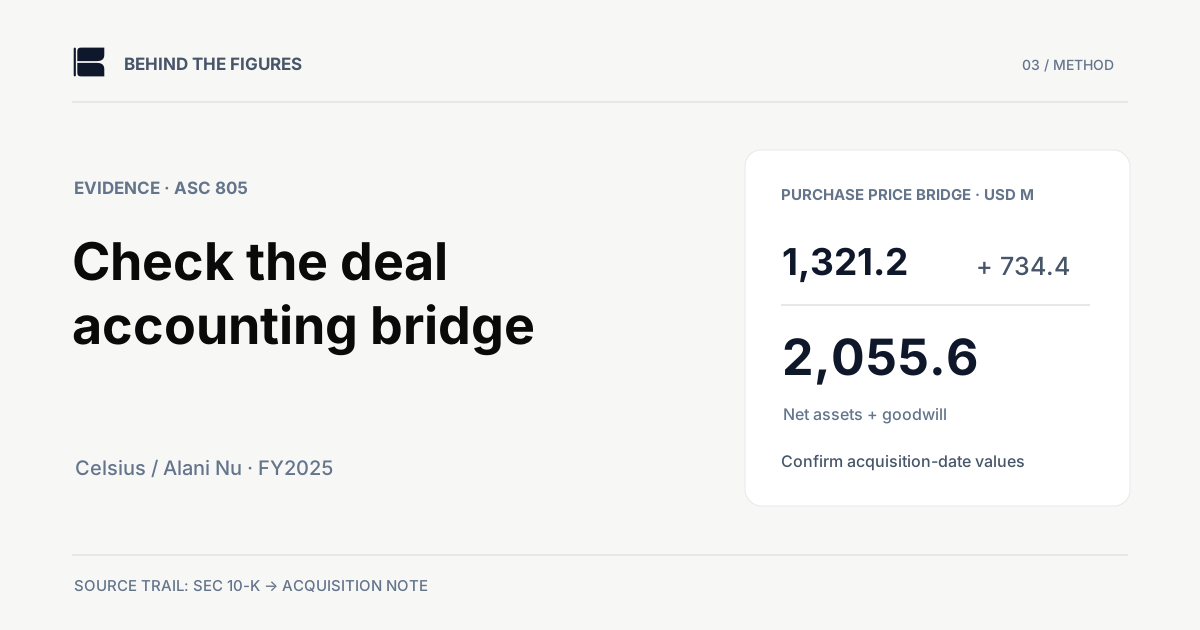
Behind the Figures: Celsius's ASC 805 Acquisition Analysis
A source-first Clarifo workflow to reconcile Celsius's Alani Nu purchase price, intangible assets and goodwill under ASC 805.
Analysis
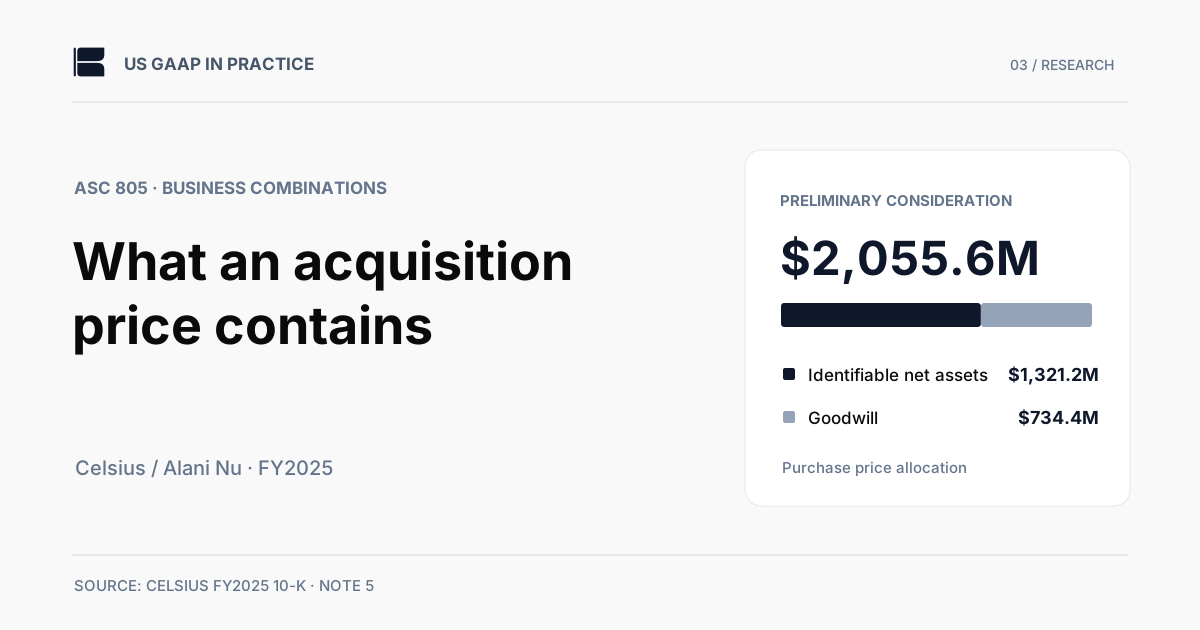
ASC 805: Celsius, Alani Nu and the $734M Goodwill Question
Celsius's Alani Nu acquisition involved $2.06B in consideration and $734M in goodwill. Explore ASC 805 purchase accounting and intangible valuation.
Learn
ASU 2026-03: contractual sale restrictions now cut fund NAV
Under ASU 2026-03, investment companies within Topic 946 must reflect lock-ups and other contractual sale restrictions as a discount in fair value and disclose it, while banks and operating companies keep the unadjusted quoted price. We show what Wells Fargo, Hercules Capital, Nvidia and Northern Trust disclose today.
Learn
Segment revenue data in 10-Ks: how US companies split profit
US companies report revenue and profit by the segments their chief operating decision maker uses (ASC 280), now with significant segment expenses, and separately by geography and product. We read Caterpillar's and Meta's FY2025 10-Ks to show what the split reveals.
Learn
SEC XBRL financial data: what it gives you and what it leaves out
SEC XBRL financial data gives you tagged facts from every 10-K and 10-Q, not a ready time series. What a company financials dataset has to add, shown on Amazon.com, Inc.'s quarterly figures.
Learn
ESEF financial data: how to read an iXBRL annual report
ESEF financial data is the machine-readable layer inside EU listed companies' annual reports. We explain iXBRL tags, the ESEF taxonomy, block-tagged notes and common pitfalls, using KONE's FY2025 report.
Learn
Nordic company financials: where the reported numbers come from
Nordic company financials are published in IFRS interim reports, annual reports and ESEF files, released as stock exchange releases on a pre-announced calendar. We trace KONE and Atlas Copco's FY2025 figures to their sources.
Learn
US company financials: reading a 10-Q without the YTD trap
A 10-Q reports the income statement for the quarter and the year to date, but the cash flow statement only year to date, and Q4 never gets a 10-Q at all. We show how to read discrete quarters correctly, using Micron's 53-week fiscal 2026.
Learn
How construction companies recognise revenue under IFRS 15
A practical guide to IFRS 15 for construction teams, covering over-time recognition, performance obligations, contract modifications and progress measures.
Learn IFRS 15 construction revenue recognition with YIT and NCC examples. Compare reported accounting policies using Clarifo in ChatGPT and Claude.
Analysis
IFRS 18 is coming in 2027. The real challenge is comparing what companies report
IFRS 18 will change how companies present operating profit from 2027. We examine the latest regulatory developments, the challenge of restating 2026 comparatives and how Clarifo helps investors and finance teams investigate source-backed reporting disclosures through ChatGPT and Claude.
Learn
IFRS 16 Works. So Why Is the IASB Reopening Parts of It?
IFRS 16 is working as intended, but some recurring application costs remain higher than expected. We examine what the IASB’s new targeted improvement project means for finance teams.
Learn
The financial reporting roadmap: what changed and what comes next
A current roadmap of IAS 28, IFRS 20, Risk Mitigation Accounting and ESRS-40a, including key deadlines, effective dates and next actions.
Learn
An Accounting Standard Is Not a Static PDF
Accounting standards evolve through issuance, endorsement, implementation and review. Effective reporting research must connect the requirement to its current lifecycle stage.
Learn
IFRS 18 Reshapes the Income Statement: What Finance Teams Need to Know
A new mandatory income statement structure, management-defined performance measures, and real Nordic company examples — what IFRS 18 means for finance teams before 2027.