
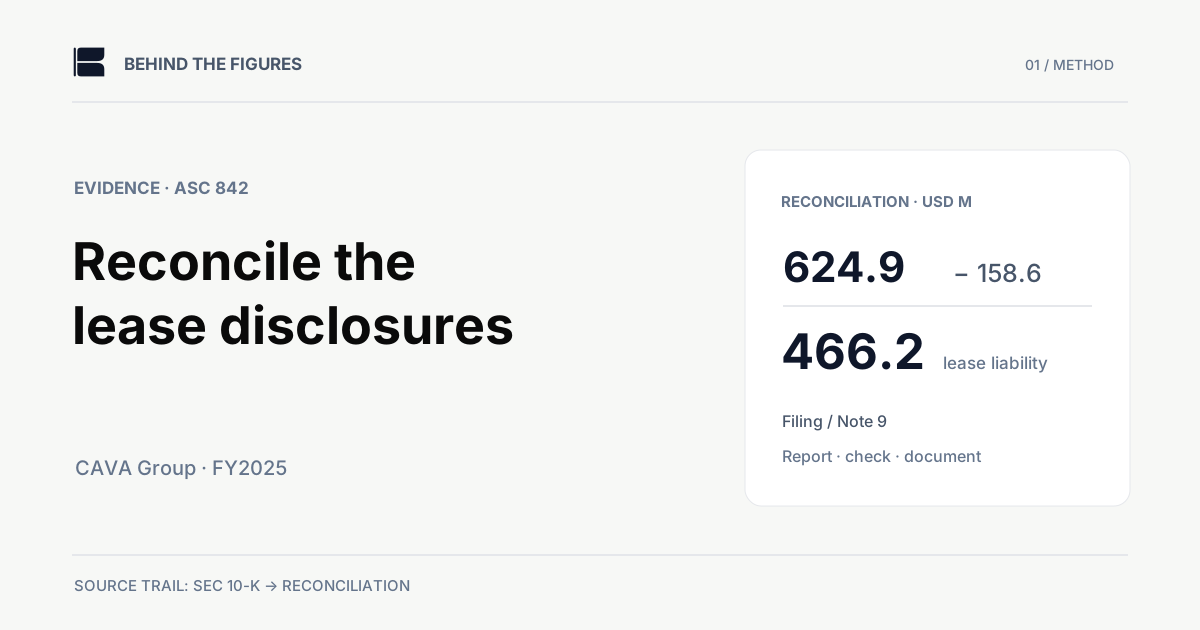
A lease footnote can look like a wall of numbers until one question gives it a structure. In CAVA Group's FY2025 Form 10-K, the company lists $624.878 million in future minimum operating lease payments, yet carries a $466.248 million operating lease liability. It also describes commitments for signed leases that have not started. The research task is not to find a single number. It is to recover the relationship between three different disclosures without blending their accounting bases.
This is the behind-the-scenes companion to ASC 842 in Practice: CAVA's Lease Commitments. The accounting article explains what the numbers mean for a restaurant business. Here we show the evidence-gathering and reconciliation process with Clarifo's filing-search capabilities, and how to organize the result into a short, auditable memo.
A useful research workflow should make it easier to verify the answer, not just easier to generate a convincing paragraph.
Start with a question that has a testable answer
The first question is narrow: Why do future lease payments exceed the recognized operating lease liability? A second question tests whether signed but uncommenced leases are included in either amount. Only after answering both should we discuss what the obligations mean for leverage or liquidity.
One FY2025 10-K
Company, reporting date and accounting topic fixed before analysis.
Multiple filing sections
Find the commitments table, lease accounting policy, and relevant risk factors.
A reconciled memo
Reported figures, calculated bridge, scope note and source references.
What Clarifo surfaced in the actual filing search
We searched the indexed CAVA filing for operating lease payments, discounting and maturity commitments. The filing search returned a cash-commitments passage in Item 7, Management's Discussion and Analysis, showing $624.878 million of operating lease payments and a $255.004 million “thereafter” amount. A separate lease-policy passage describes how CAVA uses its incremental borrowing rate when the interest rate implicit in a lease is not readily determinable. The risk factors explain that operating lease costs are a significant expense and can constrain financial flexibility.
Those hits are useful, but they are not sufficient on their own to finalize a memo. The exact present-value reconciliation belongs in Note 9. The appropriate next step is to open the original filing, verify the lease table and capture the reported units and measurement date. A semantic search result is a way to locate evidence; it is not an alternative to reading the full disclosure.
Build the reconciliation before writing the narrative
| Evidence field | FY2025 · USD millions | Classification |
|---|---|---|
| Future minimum lease payments | 624.878 | Reported, undiscounted |
| Imputed interest | (158.630) | Reported reconciliation deduction |
| Operating lease liability | 466.248 | Reported, present value |
| Signed leases not yet commenced | 146.5 | Separate commitment disclosure |
Arithmetic check: 624.878 − 158.630 = 466.248. The $146.5 million for leases not yet commenced is not added to the liability or silently combined with the maturity schedule. The filing date, currency, source note and measurement date belong beside the figures in any saved research memo.
This is where a financial research workflow delivers value: numbers from different contexts must retain their original definitions. Without that discipline, a plausible AI answer could accidentally add the uncommenced leases to a balance already defined by the maturity table, exaggerating the reported liability.
The repeatable prompt in ChatGPT or Claude
With Clarifo connected, the following prompt directs the assistant to retrieve and distinguish evidence rather than merely explain lease accounting from general knowledge. The same research question can be approached in ChatGPT or Claude; the sourced filing-search observations described above come from a Clarifo-assisted research session, not a claimed screenshot of either assistant's UI.
Using Clarifo, search CAVA Group FY2025 Form 10-K for Note 9 (Leases), the lease accounting policy, Item 7 commitments and lease risk factors. Extract minimum future lease payments, imputed interest, recognized operating lease liabilities and signed but not yet commenced lease commitments, with exact units and reporting date. Reconcile the payments to the liability. Cite each filing section and mark every amount as reported or calculated. Do not treat undiscounted commitments as the balance-sheet liability.
What the finished research memo should contain
The most useful output is not a long transcript of a chat. It is a concise document with an answer, a bridge table and a short list of assumptions. In a Clarifo Workspace research document—or an equivalent retained memo—organize the evidence into four sections: the accounting question, source evidence, numeric reconciliation, and analyst interpretation. That is a recommended documentation structure, not a claim that this particular document has already been created inside Workspace.
CAVA disclosed $624.878 million in minimum future operating lease payments at FY2025 year-end. Deducting $158.630 million of imputed interest reconciles to its $466.248 million recorded liability. Commitments for signed leases not yet commenced are disclosed separately. This explains the accounting bridge, but is not a valuation of the restaurant expansion plan.
For a more complete investment analysis, follow up with lease costs, cash paid, weighted-average lease term, restaurant openings and the timing of planned locations. Clarifo helps locate and organize those source disclosures; it does not remove the need to judge their economic relevance.
When this workflow is worth using again
The same pattern applies to retail, gyms, hospitality and other location-heavy businesses: locate the lease note, reconcile future payments to recognized liabilities, separate uncommenced commitments and compare the result with cash-generation capacity. The reusable skill is not memorizing an ASC 842 definition. It is preserving the distinction between a payment schedule, an accounting measurement and a business decision.
Try the source-first lease workflow with Clarifo in ChatGPT or Claude, or document the verified results in Workspace.
- CAVA Group FY2025 Form 10-K, Item 7, Item 1A and Note 9.
- Read the accounting analysis: CAVA and ASC 842.
- US GAAP in Practice — series index.