
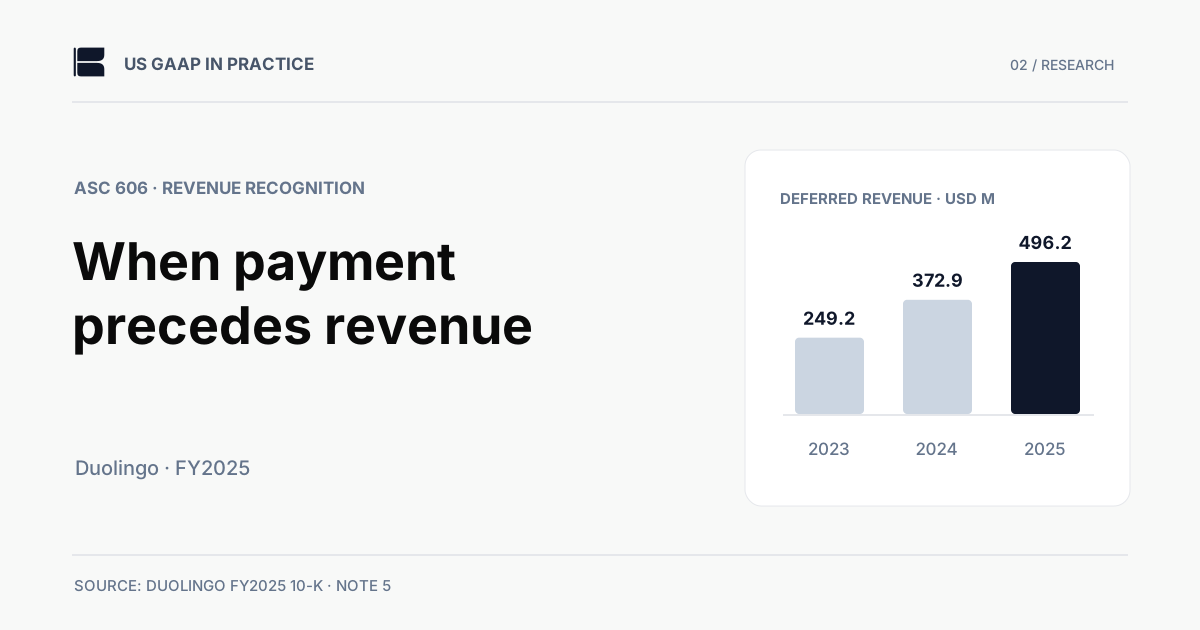
Imagine paying for a full year of language lessons today. The app has received your payment, but it has not yet delivered twelve months of access. That gap between cash collection and the service being provided is the accounting story behind Duolingo. Its FY2025 filing reported $496.2 million of deferred revenue at December 31, 2025, up from $372.9 million one year earlier. The number is large relative to a company that reported $1.038 billion in annual revenue, and it is a useful real-world example of how US GAAP ASC 606 separates billing from earning. Source: Duolingo FY2025 Form 10-K.
A subscription payment is not the same thing as revenue earned today. The accounting follows the service period, not simply the date the customer pays.
The promise behind a twelve-month subscription
Duolingo's FY2025 Form 10-K describes time-based subscriptions as a stand-ready obligation to provide hosting services that customers consume over the subscription period. Customers may buy monthly plans or pay upfront for a year, including family plans. In the filing, payments for annual subscriptions initially enter deferred revenue. Revenue is then recognized over the life of the subscription.
That is the key ASC 606 idea in this case: the company recognizes revenue when it satisfies its performance obligation by providing access, not merely when a card is charged. Duolingo also says that the app's limited offline content is highly integrated with online functionality and treated as one performance obligation with the online service.
The practical implication is that the cash, the new booking, the change in deferred revenue and reported subscription revenue can move by different amounts during a period of rapid customer growth. Without examining that bridge, an analyst can confuse customer prepayments with current-period sales.
Deferred revenue climbed to $496.2 million
The annual note gives more than the ending balance: it shows the movement of deferred revenue. This makes the story measurable rather than theoretical. Duolingo's December 2025 balance was $123.3 million higher than at the end of 2024, an increase of approximately 33.1%.
| Deferred revenue movement | FY2025 · $M |
|---|---|
| Beginning balance, January 1 | 372.884 |
| Revenue recognized from opening balance | (372.434) |
| Other recognition of deferred revenue | (572.589) |
| Deferral of revenue during the year | 1,068.345 |
| Ending balance, December 31 | 496.205 |
The movement table is reproduced from the filing's named lines. “Deferral of revenue” should not be treated as a stand-alone bookings metric, and the ending deferred balance is a liability—not cash held in a separate account.
The year-end balance is classified as current because Duolingo says its longest subscription plan runs for twelve months and the Duolingo English Test has limited purchase-to-completion windows. The filing says the balance is expected to become revenue in the coming twelve months, subject to satisfying the recognition criteria. It is therefore a measure of services still to be delivered, not a guarantee of future net cash inflows.
The same company has four different revenue clocks
ASC 606 becomes more interesting once the business has more than one way to make money. Duolingo identifies four predominant sources: subscriptions, in-app advertising, the Duolingo English Test, and in-app purchases. Their revenue-recognition timing is not interchangeable.
Over time
Access and hosting are delivered throughout the subscription term.
At placement
Revenue is recognized when an advertisement is placed.
After proctoring
Generally recognized once proctoring and the certification decision are complete.
Consumable in-app virtual goods follow another pattern: Duolingo recognizes revenue over the period the user consumes the item, generally within one month. Its filing also discusses revenue recognition if test purchases expire. These details are why a one-line description such as “all app revenue is subscription revenue” would be wrong.
In 2025, subscriptions contributed $873.442 million of $1,037.589 million in total revenue, or approximately 84.2%. Other revenue totaled $164.147 million, including $79.725 million of advertising, $42.006 million of test revenue, $40.479 million of in-app purchases and $1.937 million of other activities.
The dominance of subscriptions explains why deferred revenue deserves particular attention in this business. Still, the reported category mix does not by itself tell us whether users are paying monthly or annually, or how customer acquisition, renewals and refunds might evolve.
Deferred revenue is neither the same as total bookings nor evidence that cash will be collected again when the liability becomes revenue. It reflects an obligation to provide services for consideration already billed or received.
Why the accounting matters beyond Duolingo
The more subscription-heavy a software or consumer internet business becomes, the more important the timing of contract payments and service delivery can be. A fast-growing deferred revenue balance can accompany strong subscriptions, but it should be evaluated alongside revenue growth, customer retention, cash collections and contract duration. Even a consistent policy can produce different short-term patterns as the business mix changes.
Duolingo makes ASC 606 tangible precisely because the product feels simple to the customer. One click buys a year of learning; twelve months of access create the reported revenue. The financial statements must preserve that difference. For analysts, it is a reminder that cash collected, revenue recognized and work still owed are three different measures.
Behind the figures: For the evidence trail and numeric checks behind this analysis, read Behind the Figures: how Duolingo's deferred revenue was reconciled.
- US GAAP in Practice — Explore the complete case-study series.
- Duolingo, Inc. FY2025 Form 10-K — Note 2 (Revenue Recognition), Note 5 (Revenue) and Item 7.
- CAVA and ASC 842: lease accounting in practice — another installment in this series.
- Behind the Figures: how Duolingo's deferred revenue was reconciled — a separate Clarifo workflow and audit trail.
- US GAAP in Practice — series index.