
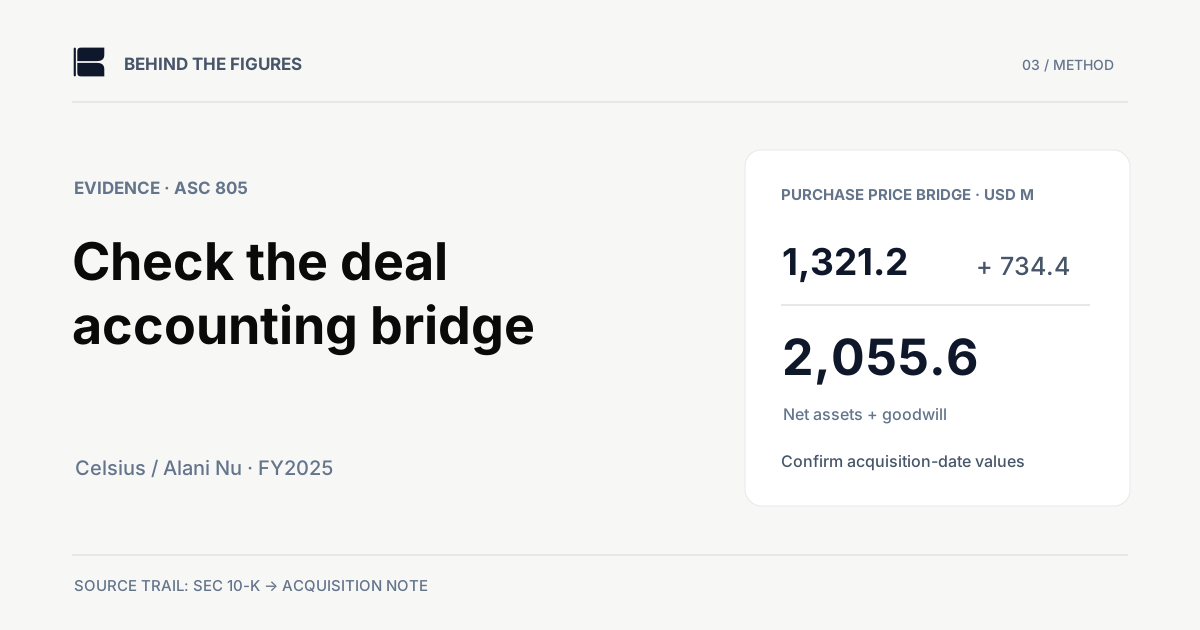
A headline may describe a company buying a beverage brand for roughly $2 billion. An acquisition note is more revealing. The accountant must identify the consideration transferred, measure the assets acquired and liabilities assumed, assign value to intangible assets and leave a carefully calculated residual as goodwill. The Celsius Holdings FY2025 Form 10-K gives a concrete case: the Alani Nu purchase involved $2,055.589 million of preliminary consideration and $734.404 million of goodwill.
This is the behind-the-scenes companion to ASC 805: Celsius, Alani Nu and the $734M Goodwill Question. That article explains the acquisition accounting story for investors and financial reporting professionals. Here we show how the figures can be retrieved, reconciled and documented with Clarifo-assisted SEC research rather than copying a purchase price allocation table without its qualifications.
A purchase price allocation is not one number. It is a chain of reported values, measurement assumptions and later changes that must remain distinguishable.
Scope the research to one acquisition and one filing
We searched Clarifo's indexed filing content for Celsius Holdings, its 2025 Alani Nu transaction, preliminary consideration, identifiable intangible assets and goodwill. The results identified the acquisition discussion in Item 7, a passage describing the acquisition method and management estimates, and an additional disclosure about a $13.8 million subsequent remeasurement of contingent consideration.
This is where the first practical benefit appears: a reader looking only for “Alani Nu purchase price” could miss the later remeasurement or confuse cash paid at closing with the accounting definition of consideration transferred. A filing-scoped search helps surface both parts of the story. Nevertheless, the source of record remains the original 10-K acquisition note, which needs to be opened and checked line by line.
First reconcile the acquisition-date consideration
| Consideration component | Acquisition-date value · $M |
|---|---|
| Cash consideration | 1,322.425 |
| Share consideration | 721.964 |
| Contingent consideration | 11.200 |
| Total preliminary consideration | 2,055.589 |
The arithmetic is exact at the filing's displayed precision: 1,322.425 + 721.964 + 11.200 = 2,055.589. The cash component in the acquisition table is not automatically the same thing as the cash-at-closing description or the net investing cash outflow in the consolidated cash flow statement. They can use different measurement dates and include different items.
The acquisition-date fair value of contingent consideration was $11.2 million. Celsius subsequently reported a $25.0 million year-end amount and a $13.8 million remeasurement effect. The later $25 million is not a substitute for the fair value originally included in acquisition-date consideration.
Then test the accounting allocation
| Purchase price allocation | USD millions |
|---|---|
| Net identifiable assets acquired | 1,321.185 |
| Goodwill | 734.404 |
| Preliminary consideration | 2,055.589 |
The second reconciliation is also exact: 1,321.185 + 734.404 = 2,055.589. Within the identifiable assets the company separately valued the Alani Nu brand at $1,104.0 million and customer relationships at $111.0 million. Those amounts are components of identifiable assets; they cannot be added to net identifiable assets and goodwill as if they were additional pieces of consideration.
$1,104.0M
Separately identified brand asset, disclosed as indefinite-lived.
$111.0M
Customer relationships, with a five-year useful life.
$734.4M
Remaining consideration after measuring identifiable net assets.
Record the judgment, not just the amount
Celsius describes judgment-heavy fair-value estimates, including expected revenue growth, discount rates, royalty assumptions and asset useful lives. The brand was valued using a relief-from-royalty methodology. A research memo should therefore record the method and reported assumption categories even when the filing does not give enough detail to independently reproduce the valuation model.
We also capture the status of the allocation: the FY2025 figures were described as preliminary. A later amendment to an acquisition-date estimate or a subsequent fair-value remeasurement is a different accounting event from the initial purchase price allocation. That distinction should appear in the memo's data dictionary, not be buried in the narrative.
How to repeat the search in ChatGPT or Claude
The following prompt reflects the filing-search steps used to identify the relevant Celsius evidence with Clarifo. It can be run with Clarifo connected to ChatGPT or Claude. The reported figures above have been assembled into this research example; no claim is made that a finished Workspace file or Claude screenshot has already been created.
Using Clarifo, examine Celsius Holdings FY2025 Form 10-K, focusing only on the April 2025 Alani Nu acquisition and ASC 805. Locate the acquisition accounting policy and Note 5. Extract cash, share and acquisition-date contingent consideration. Reconcile preliminary total consideration to identifiable net assets and goodwill. Identify separately valued brand and customer relationship assets, their useful lives and valuation methods. Find subsequent contingent-consideration remeasurement. Cite the SEC filing and label every amount as acquisition-date, year-end or calculated; do not mix the different dates or add identified assets twice.
The final deliverable is a controlled purchase accounting memo
A reusable document has a cover line specifying the target company, transaction, acquisition date, fiscal year and source filing. Its body contains two reconciliation tables, an asset-useful-life schedule, an estimate/assumption register, and an open-issues log. A researcher can retain this structure inside Clarifo Workspace or another document system and compare later filings against the original, provisional allocation.
Example decision rule: if a future filing revises acquisition-date values, preserve the version history and distinguish a measurement-period adjustment from a subsequent change in fair value. Never replace the historical acquisition-date row with the latest earnout amount.
This is what turns a generic accounting explanation into an auditable workflow. Clarifo can make the source passages and related disclosures faster to locate. The analyst still checks the original note, runs the arithmetic, records estimates and decides which questions require further investigation.
Trace acquisition accounting across SEC note disclosures, then keep a clear reconciliation and source trail.
- Celsius Holdings FY2025 Form 10-K, Note 5, Item 7 and the acquisition accounting policies.
- ASC 805 — the Celsius and Alani Nu accounting case study.
- US GAAP in Practice — series index.