
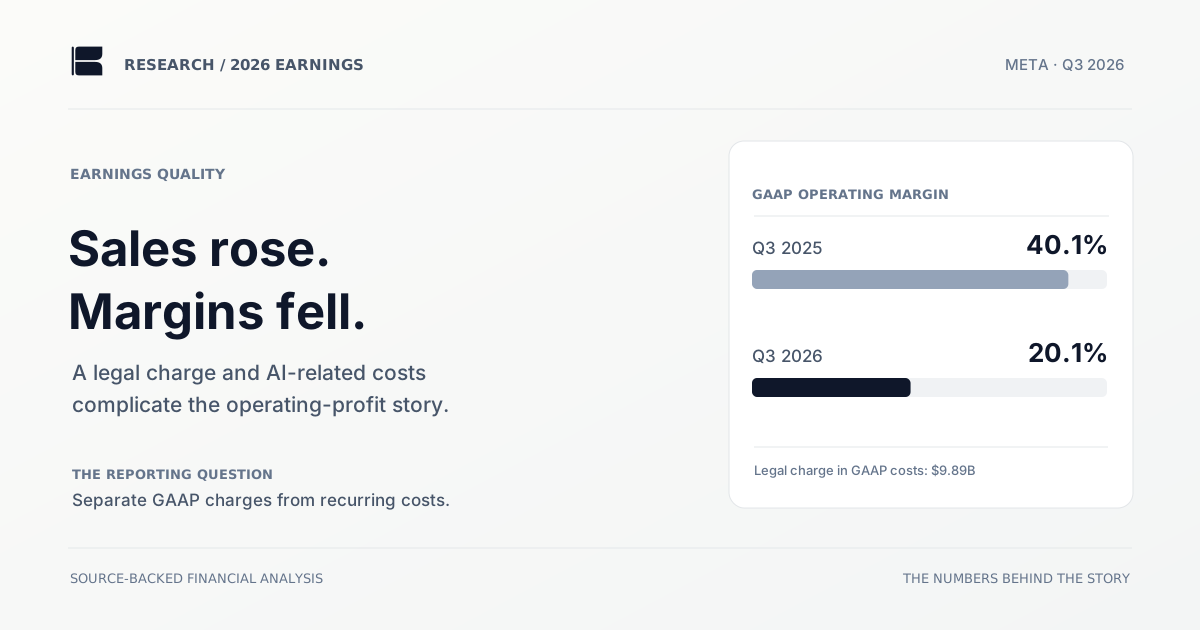
Meta Platforms, Inc. — Meta's advertising business grew rapidly in the September quarter, but its operating margin fell from 40% to 20%. It would be tempting to attribute all of that deterioration to artificial intelligence investments. The filing tells a more complicated story: reported operating expenses include a $9.89 billion charge tied to an agreement with US state attorneys general.1
Separate the legal charge from the capital spending
The official income statement reports $64.601 billion in revenue and $12.988 billion of operating profit, a 20.1% margin. The $9.89 billion charge for the state attorneys general agreement is inside GAAP costs and expenses. It explains a large portion of the apparent collapse in profitability, but deleting it from a spreadsheet would not change the legal obligation or the GAAP result.1
Meta's own illustrative reconciliation increases operating income to $22.878 billion if the charge is excluded. That is a 35.4% hypothetical margin—still a different result from the 40.1% margin in Q3 2025. This comparison shows why a one-off adjustment can be useful without telling the entire operating story: costs excluding the charge still grew while the company invested in technology and infrastructure.1
The disclosed numbers
The figures below are taken from the company's results published October 21, 2026. They describe reported performance and are not forward-looking estimates unless explicitly marked.1
| Metric | Reported amount |
|---|---|
| Quarterly revenue | $64.6B |
| Revenue growth | +26% |
| GAAP operating income | $13.0B |
| Operating margin | 20% |
| Settlement-related charge | $9.89B |
Reported margin and adjusted interpretation are different
Meta reported operating income of approximately $13.0 billion. In explaining the settlement charge, the company said operating income would have been approximately $22.9 billion without it. The latter is a useful counterfactual for understanding the period, but it does not replace the GAAP income statement.1
The agreement provides for payments of up to approximately $18.59 billion. A booked charge and the subsequent cash payment schedule are separate questions. Analysts should inspect the liability and cash flow disclosures before describing this item as a single-quarter cash outflow.1
AI spending still requires its own analysis
Removing a one-off item does not resolve the economics of Meta's AI program. Data-center investment, equipment depreciation and future financing can influence subsequent results even when the advertising business continues growing.
There is another comparison trap: net income rose sharply from the year-earlier quarter, partly because the earlier period carried an exceptionally large tax provision. A revenue-growth story, an operating-margin story and a tax-rate story must therefore be written separately before they are combined.
The key question is not whether a headline grew, but which financial obligations and accounting definitions sit behind that growth.
What the longer-term data changes
Meta reported $32.786 billion of operating cash flow and $33.942 billion of cash purchases of property and equipment in Q3 2026. It also paid $0.964 billion in finance lease principal. The company's FCF calculation is therefore $32.786 billion − $33.942 billion − $0.964 billion = negative $2.120 billion. Capital expenditure including lease principal was $34.906 billion, a broader measure than cash equipment purchases alone. These definitions must be reconciled before comparing cash returns with other companies.23
The attorneys general agreement outlines potential payments up to approximately $18.59 billion, part of which is conditional and part paid over years. Earnings recognition and the timing of payments differ, so a claim that the whole $18.59 billion left the bank in Q3 would be incorrect.1
The interpretation that needs more evidence
Meta's advertising business remains cash-generative. Evaluating AI investments requires testing future operating cash flows, equipment additions, depreciation and debt or lease arrangements together. The next report should make it possible to separate recurring cost inflation from unusual legal effects and the pace of the capital program.
Company capex including finance lease principal differs from property/equipment cash purchases retrieved from Clarifo. Use separately labelled amounts; do not derive free cash flow from an inconsistent pair.
What the next earnings report must clarify
Follow ad impressions, the average price per ad, underlying operating expense trends and capex commitments rather than extrapolating one quarter's 20% margin. Investors should retain the official GAAP result alongside any explicitly identified adjustment.1
Questions like these have appeared in investor discussion on Reddit. These comments explain the topics attracting attention; the reported figures in this article come from company disclosures. The related Clarifo analysis places this company in a broader financial context.
The original earnings release should be the reference point for any reconciliation. Historical company information is also available through Clarifo's company research page. A longer comparison should preserve reporting periods, segment definitions and adjusted-measure reconciliations rather than treating all reported growth rates as directly comparable.
Growth is not synonymous with cash generation. Inspect the statement of cash flows, commitments and the distinction between GAAP and non-GAAP results before drawing conclusions about valuation or investment returns.
The settlement charge is part of the reported GAAP quarter. A hypothetical exclusion may explain an unusual item but cannot replace the actual operating income.
- Meta — original financial results. Quarterly results and disclosures.
- Meta — SEC Form 10-Q cash-flow statement. Original cumulative cash-flow statement.
- Meta — issuer FCF reconciliation. Issuer-defined free cash flow calculation.
Q3 2026 FCF bridge: $32,786M operating cash − $33,942M equipment purchases − $964M finance lease principal = −$2,120M.
Prepared using disclosures available on October 29, 2026. Not investment advice.