
The AI infrastructure boom is easy to see in technology earnings. Cloud revenue is growing, demand for AI computing continues to rise, and Nvidia is selling more data-center infrastructure than ever.
At the same time, Microsoft, Alphabet, Meta and Oracle are committing tens of billions of dollars to data centers, servers, networking equipment and other infrastructure. The financial statements show two different versions of the same investment cycle.
For the companies building the infrastructure, cash leaves early while much of the cost reaches earnings gradually through depreciation. For suppliers, the same spending can become revenue and cash flow much sooner.
That timing difference is becoming one of the most important financial features of the AI buildout.
Microsoft is generating more cash and spending it much faster
Microsoft shows how quickly the economics have changed. In FY2023, the company generated $87.6 billion of operating cash flow and spent $28.1 billion on additions to property and equipment.1 By FY2026, operating cash flow had increased to $182.9 billion, while additions to property and equipment had reached $115.9 billion.2
On a simple operating-cash-flow-minus-capex basis, the difference increased from approximately $59.5 billion to $67.0 billion. Net income moved much faster, rising from $72.4 billion to $133.7 billion over the same period.12
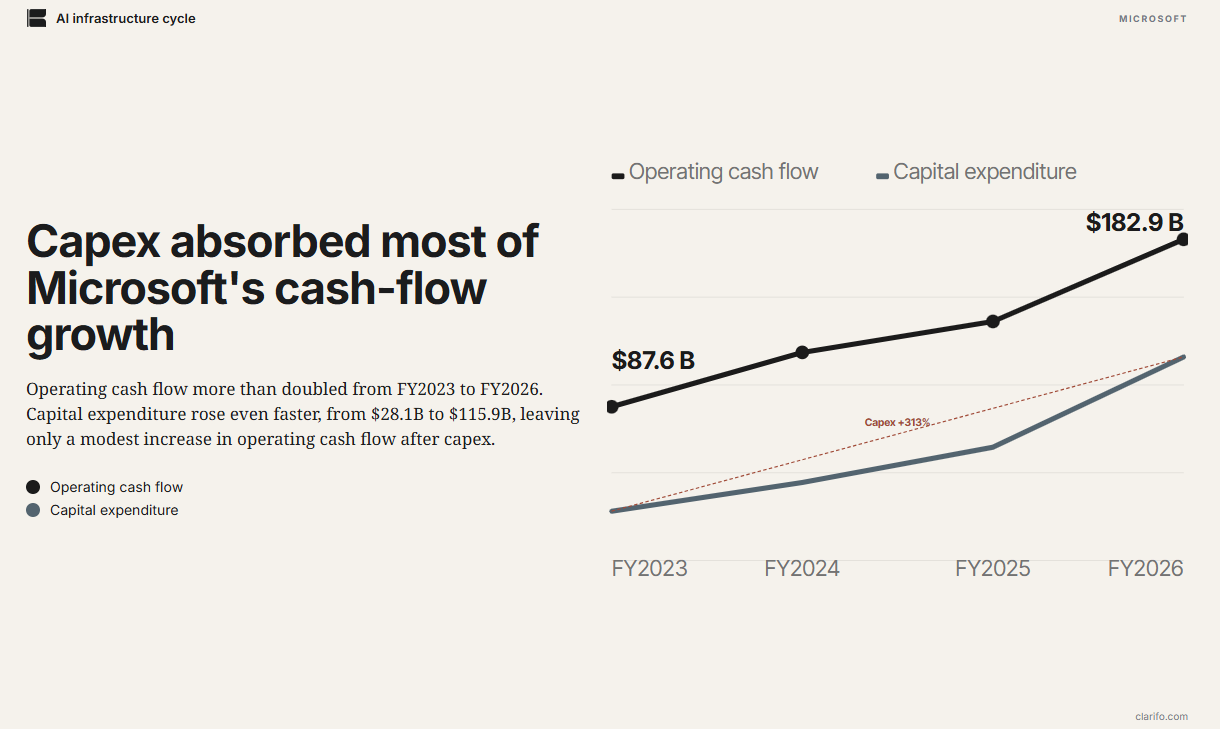
This does not mean Microsoft's investment is unproductive. The company is substantially larger and generating far more profit and operating cash flow than it was three years ago. What has changed is how much of that additional cash is being reinvested into infrastructure.
Microsoft's FY2026 filing explicitly links capital investment to cloud growth and AI infrastructure. It also describes the other side of the equation: if AI adoption develops more slowly than expected, or capacity is built too far ahead of demand, the company may not realize the expected returns. Microsoft specifically identifies underutilization and potential impairment as risks.2
The financial question is moving from how much AI capacity can be built to what return that capacity will eventually earn.
Alphabet and Meta show the same pressure on cash generation
Alphabet and Meta are following a similar path. Alphabet generated $101.7 billion of operating cash flow in 2023 and spent $32.3 billion on property and equipment. By 2025, operating cash flow had increased to $164.7 billion, while capital expenditure had reached $91.4 billion.3
Operating cash flow less capex therefore increased only modestly, from approximately $69.5 billion to $73.3 billion. Meta shows a similar relationship: operating cash flow rose from $71.1 billion in 2023 to $115.8 billion in 2025, while purchases of property and equipment increased from $27.0 billion to $69.7 billion.4
Again, the point is not that cash generation has stopped growing. It has not. The point is that infrastructure spending is absorbing an increasingly large share of that growth.
Oracle shows the more aggressive end of the buildout
Oracle makes the capital intensity particularly visible. The company spent $8.7 billion on capital expenditures in FY2023, compared with $55.7 billion in FY2026.56 FY2026 operating cash flow was $32.0 billion.
Using Oracle's definition of free cash flow as operating cash flow less capital expenditures, the figure moved from approximately $8.5 billion in FY2023 to $11.8 billion in FY2024, then fell to roughly negative $0.4 billion in FY2025 and negative $23.7 billion in FY2026.
The filing explains where the cash is going. Expanding Oracle Cloud Infrastructure requires additional data-center capacity, power, networking equipment, servers, GPUs and memory. Oracle has also entered into long-term commitments with data-center providers and equipment suppliers.6
Those commitments create a different risk from ordinary software investment. If customer demand develops more slowly than expected, Oracle can be left with infrastructure obligations and capital expenditure without the corresponding revenue. The company explicitly warns that poor capacity planning could reduce profitability.6
A note on the figures: capital expenditure in this analysis is total reported capital expenditure or additions to property and equipment. It is not a separately disclosed measure of “AI capex”. The filings do, however, directly identify cloud, data-center and AI infrastructure as important drivers of the current investment cycle.
Nvidia records the other side of the transaction
The supplier economics look very different. Nvidia reported $27.0 billion of revenue, $4.2 billion of operating income and $5.6 billion of operating cash flow in FY2023.7 By FY2026, revenue had reached $215.9 billion, operating income $130.4 billion and operating cash flow $102.7 billion.8
Calculated as operating income divided by revenue, operating margin increased from approximately 15.7% to 60.4%. Nvidia's FY2026 filing directly links much of that growth to the data-center investment cycle: Data Center computing revenue grew 59% year over year, while Data Center networking revenue grew 142%.8
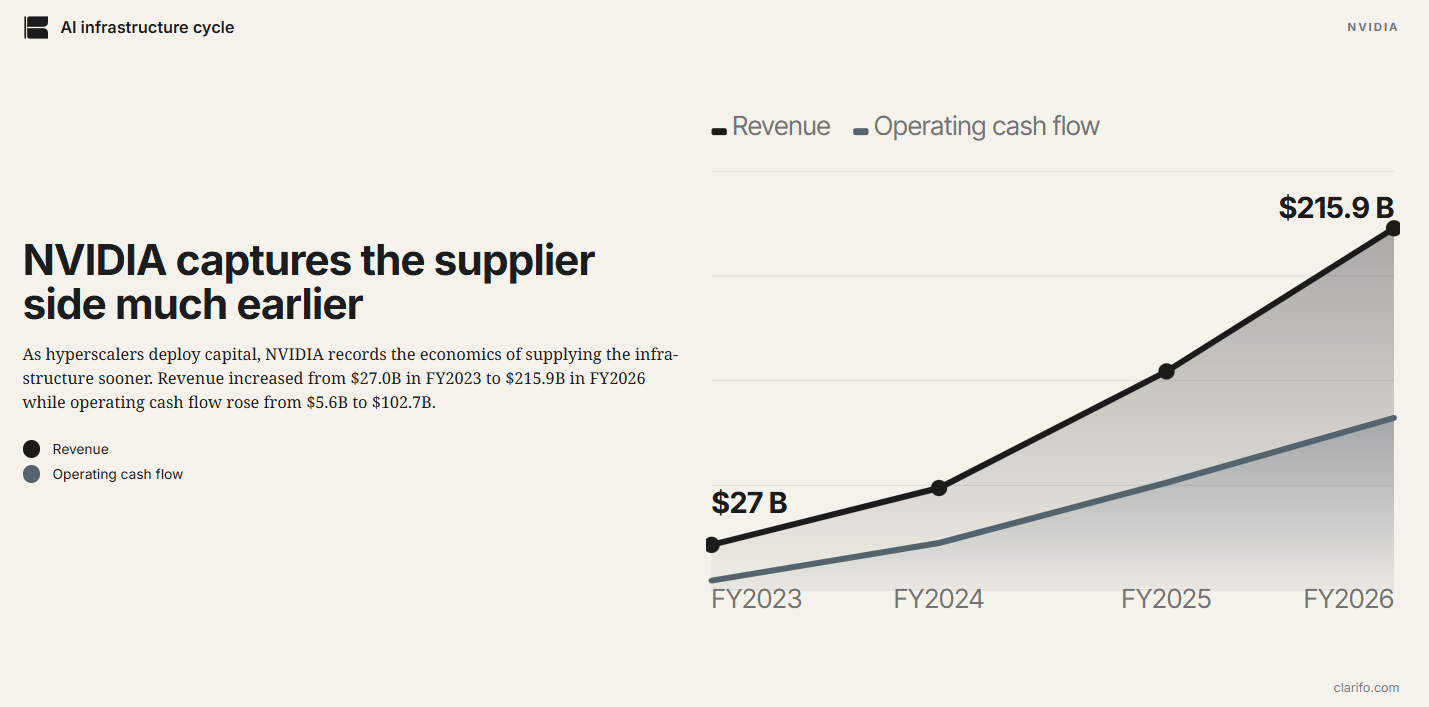
This is the other side of hyperscaler capex. When a cloud provider buys accelerators, servers or networking equipment, the supplier can recognize the economics of providing that infrastructure relatively quickly. The buyer still has to fill the capacity, generate revenue from it and ultimately earn an adequate return on the asset.
The accounting timing matters
The difference between cash flow and reported earnings is central to understanding the cycle. When a company builds a data center or purchases servers and related equipment, qualifying costs are generally capitalized rather than expensed immediately. The cash expenditure happens upfront, while the income statement recognizes much of the cost gradually through depreciation.
This means reported profit can remain strong even while capital expenditure rises sharply. It also means that part of the accounting impact of today's infrastructure buildout will only become visible in future periods as more assets are placed into service and depreciation increases.
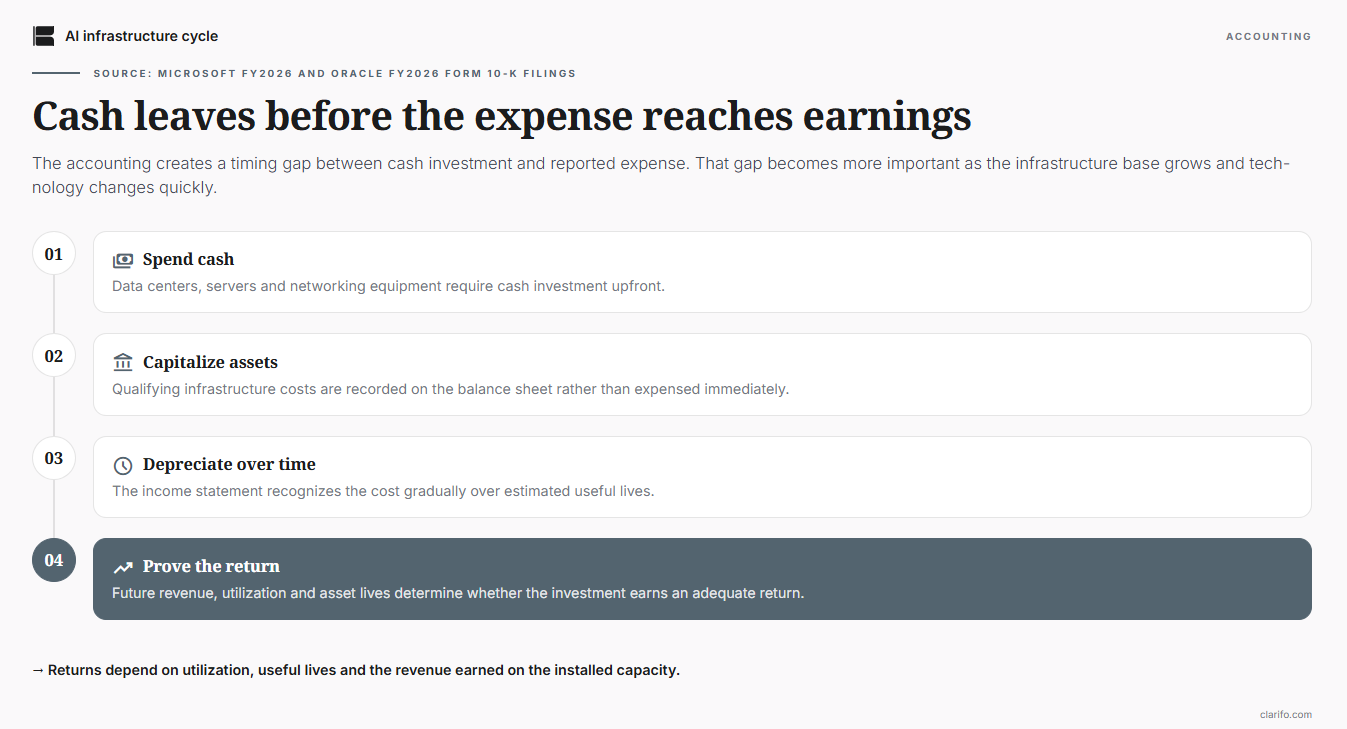
The timing becomes more important when technology changes quickly. If infrastructure becomes obsolete faster than expected, utilization is weaker than anticipated or future demand does not justify installed capacity, companies may have to reassess useful lives, expected returns or asset values.
Microsoft already identifies underutilization and impairment as explicit risks. Oracle describes a related exposure through long-term capacity commitments that may remain even if the associated customer revenue does not materialize as expected.26
The next phase is a return-on-capital test
Nothing in the current financial data demonstrates that the AI infrastructure buildout is failing. Microsoft, Alphabet and Meta are generating substantially more operating cash flow than they were several years ago, Oracle is expanding its cloud infrastructure rapidly, and Nvidia's results show just how much demand is already moving through the supply chain.
But the questions investors need to ask are changing. The next phase is less about whether companies can build AI capacity and more about what that capacity earns once it is in place.
Does capex growth begin to moderate as new capacity comes online?
Does operating cash flow eventually grow faster than infrastructure spending?
How quickly does depreciation increase as the asset base expands?
Can AI and cloud revenue generate enough incremental operating profit to justify the investment?
Does utilization remain high as additional capacity becomes available?
The amount being spent on AI infrastructure is already visible. What matters next is what companies earn on what they have built.
Sources
Microsoft Corporation, Form 10-K, fiscal year ended June 30, 2023
Microsoft Corporation, Form 10-K, fiscal year ended June 30, 2026
Meta Platforms, Inc., Form 10-K, year ended December 31, 2025
Oracle Corporation, Form 10-K, fiscal year ended May 31, 2023
Oracle Corporation, Form 10-K, fiscal year ended May 31, 2026
NVIDIA Corporation, Form 10-K, fiscal year ended January 29, 2023
NVIDIA Corporation, Form 10-K, fiscal year ended January 25, 2026
Financial figures are based on company SEC filings and were retrieved and compared using Clarifo. Fiscal year ends differ between companies, so annual periods are not perfectly aligned on a calendar basis. Operating cash flow less capital expenditure is used as a simple analytical comparison where stated. Not investment advice.

Research the numbers behind the story
Use Clarifo to search filings, compare financials and trace figures back to the original company reports across 7,500+ US and Nordic listed companies.
Try Clarifo Pro free for 7 days.
```