
Anthropic made its registration statement public on October 26, 2026. The Form S-1 holds three years of audited financial statements, an unaudited first half of 2026 and dozens of notes. The most telling details are rarely on the first pages: they sit in the risk factors, the equity note and the fair-value tables.
We have indexed the whole filing, so you can ask it questions. Below we use it to answer three that an investor would ask, show where each answer comes from, and compare Anthropic with a company that is already listed. You can ask the same questions on Clarifo, in Claude or in ChatGPT.
1. How much restricted stock unit expense is still to come?
Anthropic pays part of its employees' compensation in restricted stock units (RSUs). For a company that has not yet listed, the timing of the expense matters as much as the amount. We asked how it will be recorded.
How much of Anthropic's RSU expense would be recorded when the IPO completes, and how much is spread over later years? Use the S-1.
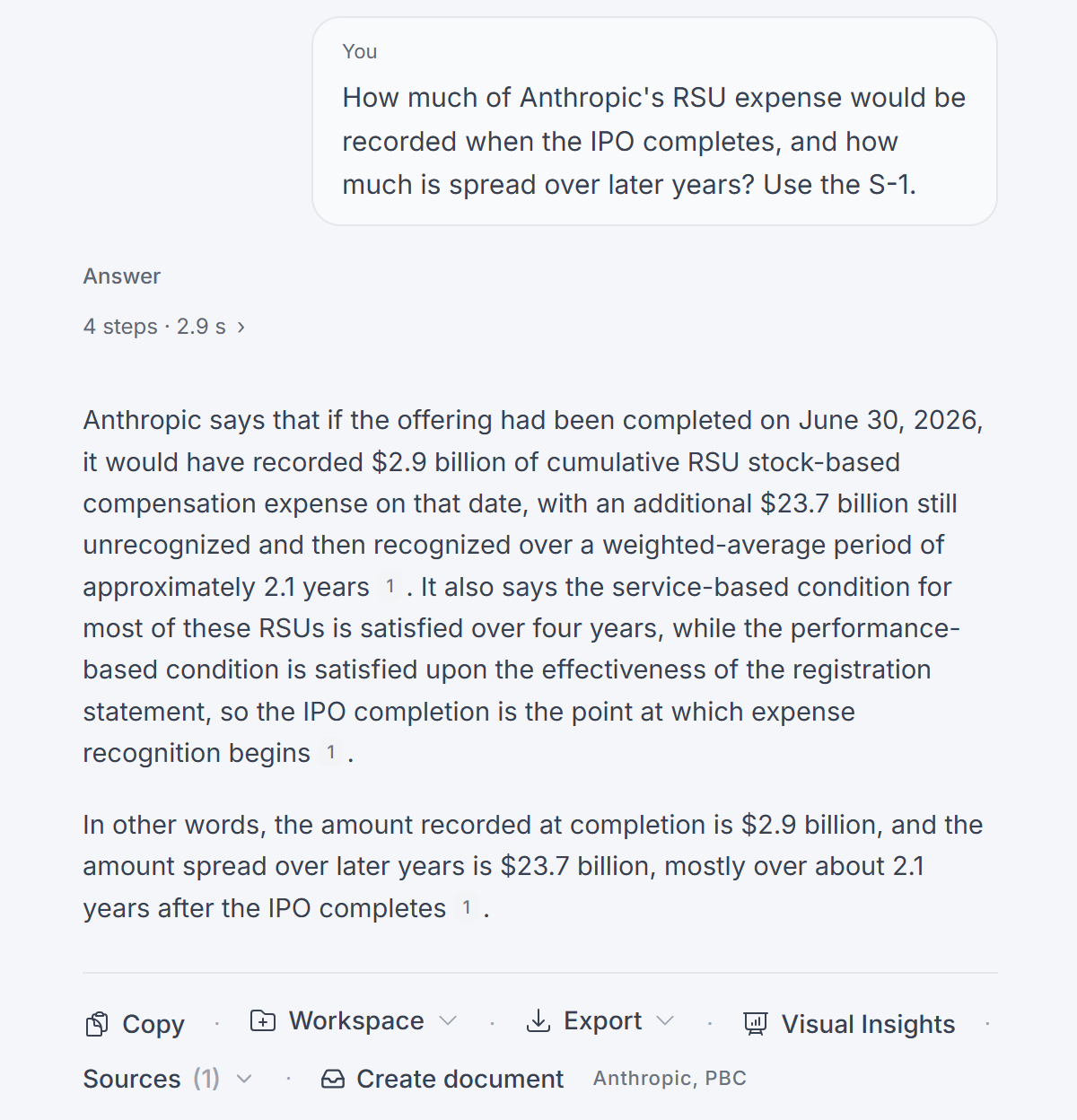
The answer comes from one paragraph on page 64 of the S-1. The RSUs vest when two conditions are met: a service condition, which is satisfied over four years for most of the awards, and a performance condition, which is satisfied when the registration statement becomes effective. No expense had been recorded for these RSUs at June 30, 2026, because that event was not yet probable.
Once the offering is completed, recording begins. Had the offering been completed on June 30, 2026, Anthropic would have recorded $2.9 billion of cumulative expense on that date, and a further $23.7 billion would be recognized over a weighted-average period of about 2.1 years. Together that is $26.6 billion. The S-1 adds that Anthropic had another $3.1 billion of unrecognized expense on other equity awards, expected to be recognized over about 1.3 years.
Every figure in an answer carries a citation. Click it and Clarifo opens the filing at that passage and highlights the sentence the figure comes from, so you can read it in its original context.
2. Why was the net loss $80.7 billion?
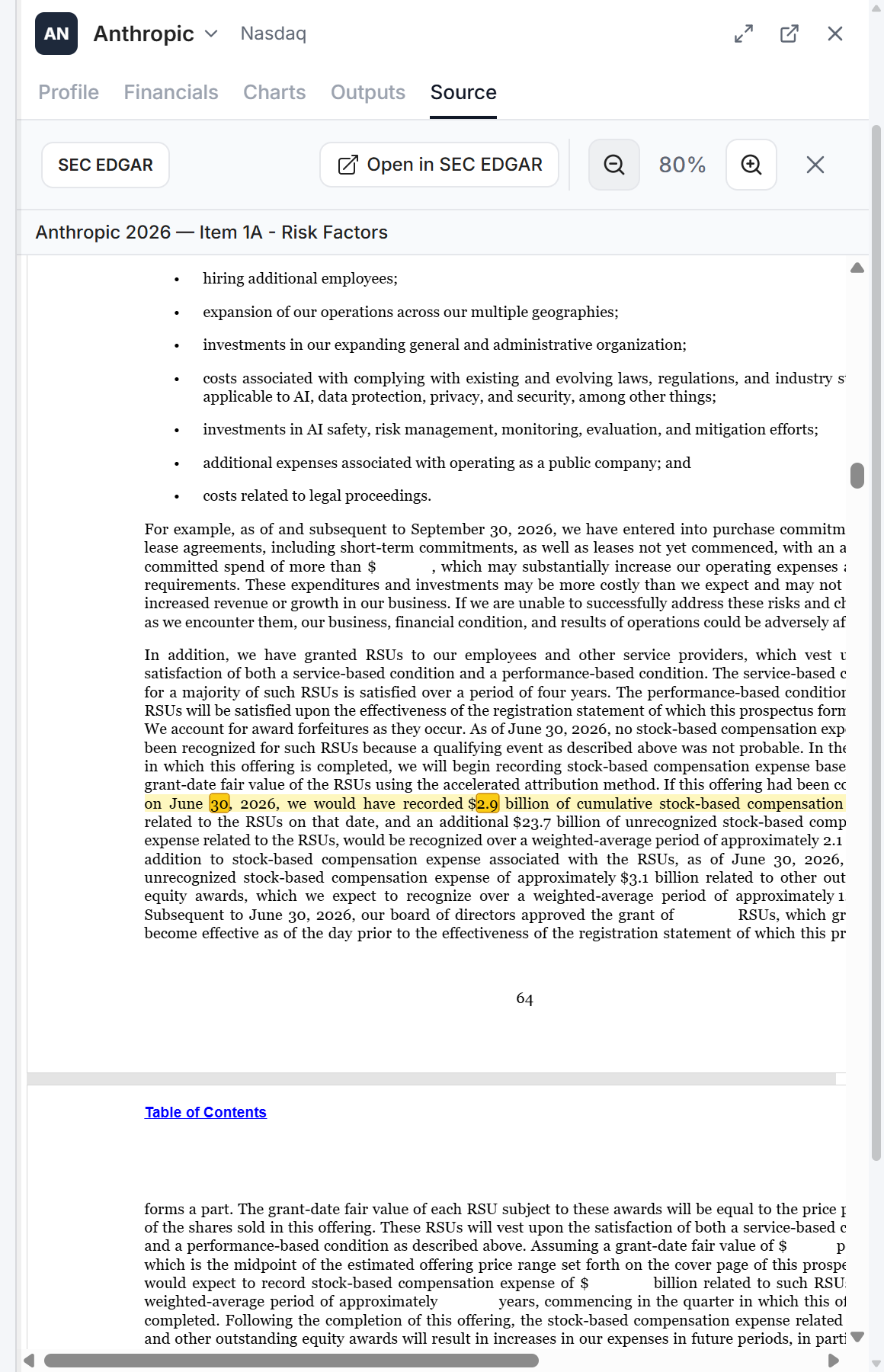
The headline loss is the number most people will quote, and on its own it says little about the business. Anthropic's operating loss for the first half of 2026 was $0.7 billion. The difference sits in a line most readers skip.
Why was Anthropic's net loss $80.7 billion in the first half of 2026 when its operating loss was only $0.7 billion?
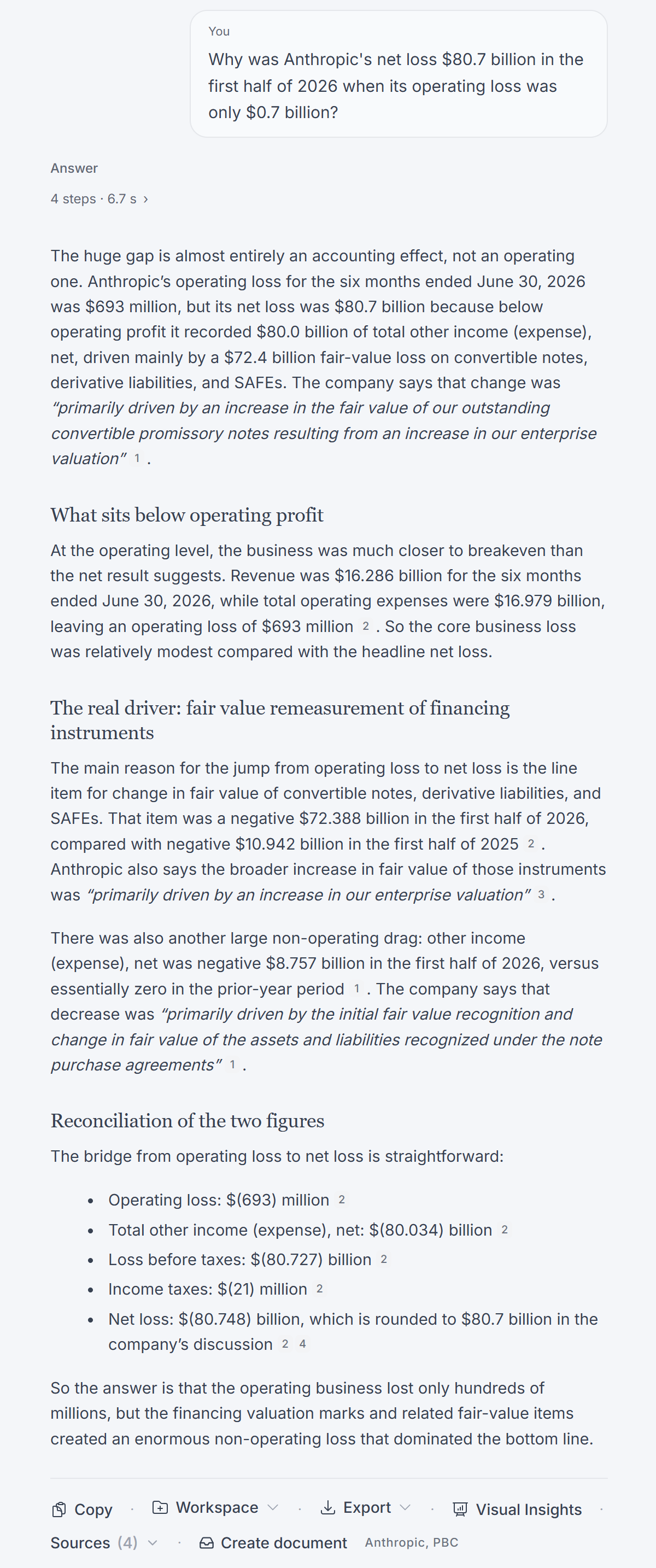
| H1 2026, USD billion | |
|---|---|
| Operating loss | -0.7 |
| Interest income | +1.1 |
| Fair-value change on convertible notes, derivatives and SAFEs | -72.4 |
| Other income (expense), net | -8.8 |
| Income taxes | -0.0 |
| Net loss | -80.7 |
Anthropic funded much of its growth with convertible notes that turn into shares. As its valuation rose, the notes became worth more, and accounting records that increase as an expense: $72.4 billion in the first half of 2026. The S-1 says the change was primarily driven by an increase in enterprise valuation. These charges move no cash. Over the same period the business generated $3.9 billion of cash from operations.
3. How does it compare with a listed company?
A filing this long is hard to compare by hand: the same item has a different name, sits in a different note and covers a different period in every company's report. With Clarifo the comparison is one question, and each figure keeps its own source. Here we compare stock-based compensation as a share of revenue with Palantir, a US software company with a calendar fiscal year.
Compare stock-based compensation as a share of revenue for Anthropic and Palantir in fiscal year 2025.
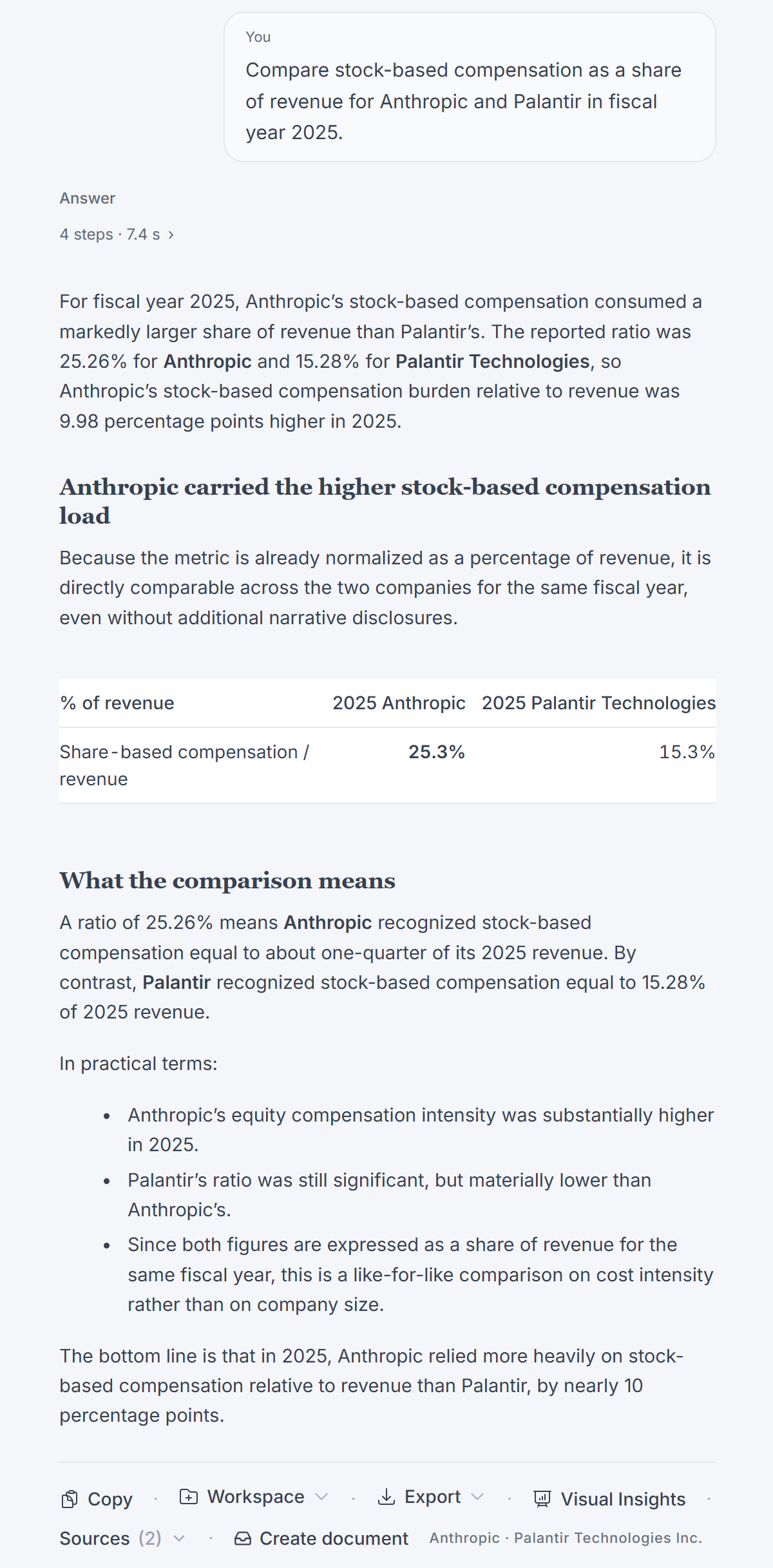
| Fiscal year 2025, USD million | Anthropic | Palantir |
|---|---|---|
| Revenue | 4,585 | 4,475 |
| Stock-based compensation | 1,158 | 684 |
| Share of revenue | 25.3% | 15.3% |
Anthropic's stock-based compensation was about a quarter of its 2025 revenue, almost ten percentage points above Palantir's. In the first half of 2026 the ratio fell to 13.4% ($2.2 billion on $16.3 billion of revenue), because revenue grew faster than the expense.
Note: both companies report a fiscal year that ends in December, so the periods are directly comparable. Ratios are calculated by Clarifo from the reported figures; the first-half 2026 ratio uses Anthropic's unaudited interim figures.
Other details worth asking about
- Voting control. A Founder LLC of the seven co-founders will hold Class F stock carrying 50.1% of the voting power.
- Lock-up. Existing shares are released in stages under 180-day and 365-day lock-ups, not all at once.
- Revenue mix. 80.2% of first-half 2026 revenue was consumption-based, and about 48% was sold through cloud provider marketplaces.
- Public Benefit Fund. 5% of fully diluted shares went to the Anthropic Public Benefit Fund.
Three ways to ask
Search
Ask in the search bar at clarifo.com. Answers show their sources, and you can continue the work in a workspace.
Clarifo connector
Add Clarifo from the Claude directory and ask in any chat. Claude calls our tools when a question needs filing data.
Clarifo app
Connect the Clarifo app in ChatGPT. The same filings and figures, with the same citations.
Read Anthropic's S-1 by asking questions, and compare it with Nordic and US listed companies.
- Anthropic, PBC, Form S-1 filed with the SEC on October 26, 2026 (accession 0001628280-26-067168), page 64 and the income statement.
- Palantir Technologies Inc., Form 10-K for the fiscal year ended December 31, 2025 (accession 0001321655-26-000011).
Not investment advice. Figures are based on data reported by the companies; ratios are calculated by Clarifo.