
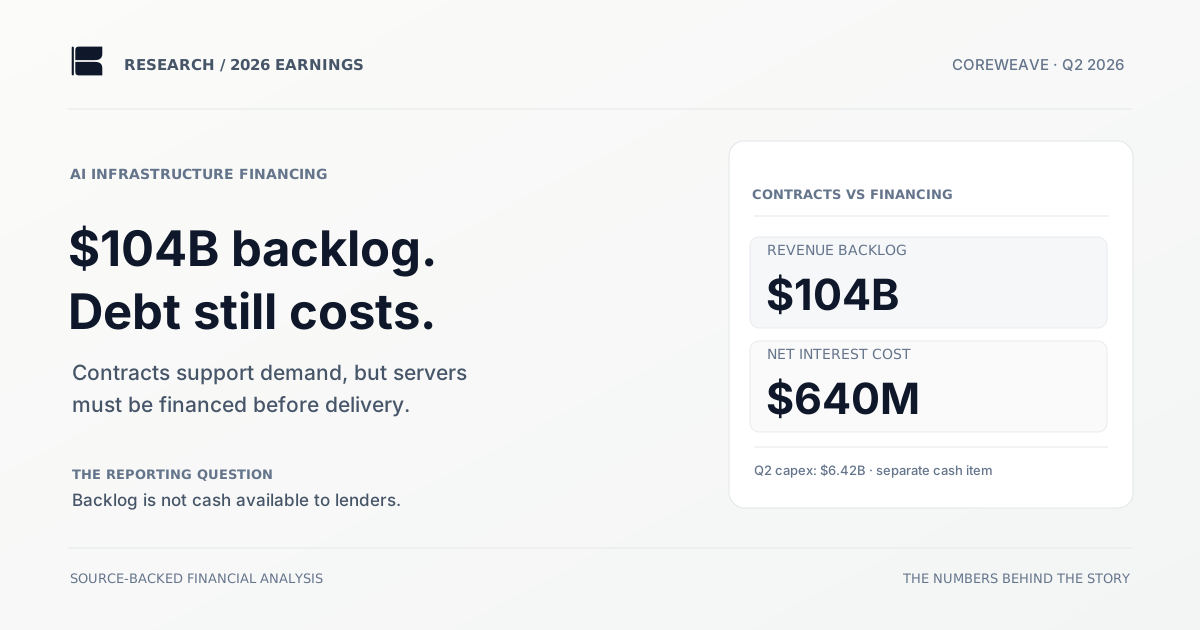
CoreWeave, Inc.: CoreWeave is a stark example of the difference between contracted AI cloud demand and the cost of financing the infrastructure required to serve it. In its second-quarter 2026 results, revenue reached $2.575 billion and revenue backlog was approximately $104 billion. Yet the company recorded a $626 million net loss and $640 million of net interest expense.1
The eight-quarter context
CoreWeave reported $2.575 billion in second-quarter 2026 revenue, more than double the same period a year earlier, and approximately $104 billion of revenue backlog. Its business shows that AI demand is very real. It also shows that delivery economics can be challenging when a fast-growing cloud provider finances its own specialized infrastructure.1
The distinction between adjusted EBITDA and operating profit is crucial. CoreWeave reported $1.510 billion of adjusted EBITDA, yet a $49 million GAAP operating loss and a $626 million net loss. Net interest expense reached $640 million. The hardware depreciation and financing burden are economically material, even when excluded from an adjusted operating presentation.1
The reported evidence
These figures refer to the August 11, 2026 financial release. Where a source distinguishes GAAP and non-GAAP results, those definitions are preserved. Outlook and backlog measures have different recognition conditions from historical sales.1
| Financial metric | Reported amount |
|---|---|
| Q2 revenue | $2.575B |
| Q2 net loss | $626M |
| Net interest expense | $640M |
| Revenue backlog | ~$104B |
| Adjusted EBITDA | $1.51B |
Adjusted EBITDA and GAAP earnings lead to different conclusions
CoreWeave disclosed adjusted EBITDA of $1.51 billion, compared with a GAAP operating loss of $49 million. That is not a contradiction. Adjusted EBITDA excludes categories including depreciation and financing expenses that are economically important for a company built around expensive hardware.1
The GAAP net loss and interest expense make the capital structure visible. Analysts should not present the EBITDA margin as if it were free cash flow or cash available for shareholders after reinvestment.
Backlog still depends on delivering capacity
CoreWeave defines revenue backlog to include remaining performance obligations and other estimated revenue from committed contracts, subject to delivery and availability conditions. The $104 billion amount is not immediate cash and is not identical to the ASC 606 RPO line.1
Active power reached 1.5 gigawatts while contracted power was approximately 3.7 gigawatts. The gap illustrates the scale of future deployment still ahead, together with the financing and execution risk required to bring that contracted capacity online.1
Reported growth is only one part of a financial story. Cash generation, capital requirements and the quality of earnings determine what can be sustained.
What the cash-flow statement adds
Clarifo's SEC cash-flow series shows Q2 2026 operating cash flow of about $679 million and cash capex of $6.422 billion. The simple operating-cash-less-capex result is approximately negative $5.743 billion. In Q2 2025 those figures were negative $251 million and $2.453 billion, respectively, a substantially smaller but still negative cash gap. Contracted demand is not itself enough to finance the capacity buildout.1
The $104 billion backlog includes remaining performance obligations and other estimated future revenue from committed contracts, subject to service availability and delivery conditions. It is therefore not strictly interchangeable with ASC 606 RPO, and it is not a deposit account full of customer cash.1
The question investors still need answered
The company reported active power capacity around 1.5 GW against contracted power of about 3.7 GW. Those are infrastructure-capacity measures, not GAAP revenue or profit. Investors need to assess whether additional commissioned megawatts translate into sufficient operating cash to service debt and replace depreciating computing equipment over time.1
CoreWeave's backlog is broader than ASC 606 RPO. The Q2 figures are from August 11, 2026; they are not a new Q3 earnings release. Cash-flow comparisons are derived from SEC XBRL.1
The financial question for the next quarter
Track operating cash flow, actual equipment spending, borrowing costs, debt maturities, active versus contracted power, and the conversion of backlog into recognized revenue. A refinancing risk cannot be inferred from Reddit speculation alone.
Reddit discussions helped identify why investors are debating this topic. They are not the source for financial numbers and can include mistaken claims. All reported figures above should be reconciled to the original earnings source.
To extend the work beyond one reporting period, explore historical numbers and original filing references at CoreWeave, Inc. on Clarifo. A defensible comparison keeps GAAP and non-GAAP measures distinct and checks whether segment definitions, acquisitions or cash-flow classifications changed.
Quarterly revenue, stock-market reaction and backlog do not establish future intrinsic value. Forecasts and analyst expectations should remain separate from reported results, especially when financing or one-off items materially affect profits.
CoreWeave's revenue backlog uses a company-defined scope broader than GAAP revenue or simply ASC 606 remaining performance obligations. It is not cash collected.1
- CoreWeave — original earnings statement and SEC filing. Primary source for the reporting period.
Based on the information available October 29, 2026. Educational analysis, not investment advice.